
Living With a Sco...
Oct 13, 2026
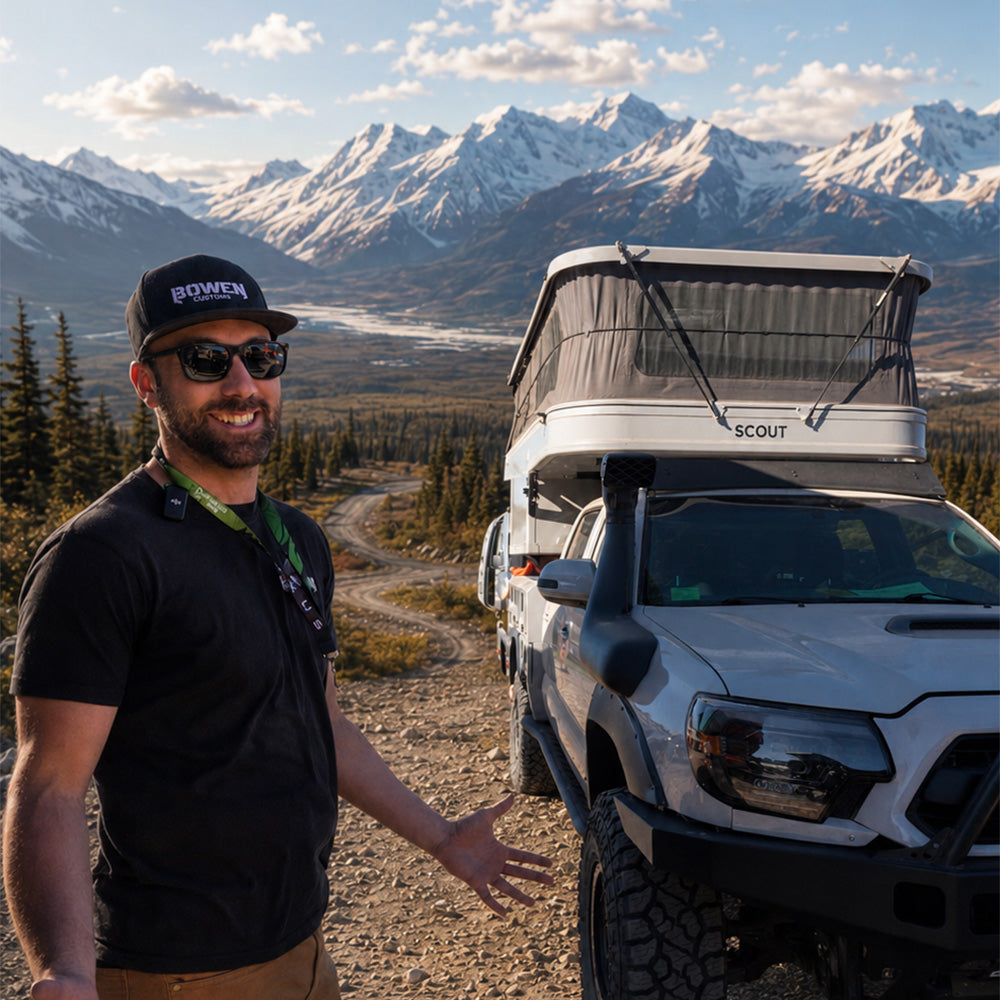
Stu Turner has spent the past two years preparing his second generation Toyota Tacoma for a journey from Alaska to Argentina. The build combines a Scout Yoho Pop Up, a Bowen Customs bed, and countless hours of personal fabrication.
But the goal is bigger than building an impressive truck.
For Stu, preparing for the Pan American Highway is about becoming more capable, more adaptable, and more comfortable with the unknown.
Stu has wanted to live and travel from a vehicle for years. The first spreadsheet he created comparing the costs of van life dates back to 2019.
The Pan American Highway became a specific goal after he discovered Toyota World Runners and Dan Grec of The Road Chose Me on YouTube. Their travels helped him see what was possible.
At the time, however, Stu did not have the money or freedom needed to attempt an expedition of this scale. “This expedition has nothing to do with simply driving lots of miles,” Stu said. “It’s about becoming the kind of person I’ve always wanted to be.”
That person has the freedom to explore, create lasting memories, share stories, and remain calm when the trip becomes difficult. That could mean navigating a stressful border crossing, dealing with corruption, or repairing the truck on the side of a hot and dusty road.
Stu plans to depart in 2027 and travel the full route from Alaska to Argentina. He is already giving himself room for the delays and scope changes that come with preparing for such a major trip. Along the way, he is looking forward to the Alaskan wilderness, swimming holes in Baja, waterfalls in Mexico, coffee in Colombia, and eventually reaching Patagonia.
The experience will inevitably bring extremes. “One day you’re in a full blown flow state jumping off cliffs into a lagoon,” Stu said. “The next you’re broken down on a hot, dusty side road.”
His truck needs to support both.
Plenty of people encouraged Stu to start with a full size truck. A larger platform would provide more payload and living space, but it would also change where the vehicle could go. Stu still wants to explore difficult trails and remote places where a larger truck could become a limitation.
The Tacoma also came with two practical advantages. It was already sitting in his driveway, and he knew the platform intimately. Stu had previously rebuilt a Tacoma from the ground up. That experience gave him a working knowledge of nearly every nut and bolt on the truck. For an international expedition, understanding how the vehicle is assembled can be just as important as choosing the right equipment.
The second generation Tacoma also shares some parts compatibility with Toyota Hilux and Toyota Fortuner models found throughout Central and South America. That does not eliminate the challenges of finding parts abroad, but it helped support his decision to stay with a familiar Toyota platform.
Using a midsize truck required careful compromises. Payload, storage, fuel economy, and interior space have influenced nearly every part of the build. Stu boxed the frame and added Archive Garage XD leaf springs and Hammer Hangers. He also removed the rear seat to create more usable storage and reduce unnecessary weight. New gearing and a larger brake system are planned before departure.
Even with those upgrades, Stu does not treat weight as an afterthought. “On the Tacoma platform, with everything you do, you have to keep weight in mind,” he said.
The camper was one of the most important decisions in the build.
Stu considered lighter topper systems with custom interiors, but his individual Scout Yoho Pop Up weighed 987 pounds. That placed it close to the weight of some topper and interior combinations he had seen while providing a fully enclosed slide in camper. For Stu, the tradeoff made sense. The Yoho offered a sealed living space, a finished interior, and greater comfort without forcing him into a much larger truck.
He chose the pop up Yoho specifically for international shipping and difficult trails. Shipping container clearance can become an important consideration when moving a vehicle between continents. The lower travel height of the pop up camper gives Stu more options than the taller hardwall version.
It also helps on narrow and off camber trails where branches and rocks can come close to the upper portion of the camper. “I’ve already bashed the latches on my Pop Up, so I know I made the right decision for my use case,” Stu said.
At 6 feet 4 inches tall, Stu selected the bunk extension to create the largest sleeping area possible. Inside, he appreciates the simplicity of the layout and the ability to personalize the camper using its interior extrusion.
The Unbound Power Tower has also become one of his favorite features. Once he learned how the system worked, it gave him a convenient foundation for adding and modifying electronics.
Most importantly, the camper is already being tested. Stu has spent more than 30 nights in the Yoho while refining the truck for longer travel. Compared with his previous setup, the difference in comfort is substantial. Stu says, “This thing is like the Four Seasons!”
Stu is the Customer Service Manager at Bowen Customs, which gave him both the product knowledge and workshop access needed to take on the bed installation himself. He assembled and installed the Bowen Customs bed after hours so the project would not interrupt the regular shop workflow.
The replacement bed helps address one of the Tacoma’s biggest limitations: storage. Exterior compartments provide space for tools, recovery equipment, vehicle supplies, and other items that do not need to occupy the camper. A custom water tank also adds 13 gallons of capacity beneath the camper. Stu personally tested, installed, and secured the tank. He also designed and welded a custom rear hitch step and completed the rear seat delete himself.
His original build requirements were simple: keep components lightweight, make every addition useful, and maximize the truck’s available capacity. The finished solution was not obvious from the beginning. Stu considered Tacomas, Tundras, Ford F-350s, and Ram trucks before returning to the Tacoma he already owned.
The final visual direction began with an artificial intelligence rendering and a note saved on his phone. That early concept also helped him decide to color match the Bowen Customs bed and Scout Camper to the truck.
The finished truck may look cohesive, but getting it to this point required two years of work outside Stu’s regular job. He assembled the bed, completed fabrication, installed the water system, built storage, and worked through the countless details that are difficult to see in a finished vehicle.
“I can’t tell you how many times I was exhausted after work or on a weekend and forced myself to continue,” Stu said. He genuinely enjoys working on vehicles, but even he was surprised by the time involved.
“I think most people don’t understand the hundreds, if not thousands, of hours that go into preparing a vehicle for a major expedition like this.”
That work also gives Stu an important advantage. When something fails far from a familiar shop, he will understand how many of the truck’s systems were designed and installed.
Every system needs to support daily life on the road without making the vehicle unnecessarily complicated. Stu removed the camper’s propane system and installed a gasoline powered heater connected directly to the Tacoma’s fuel tank. This reduces the number of fuel sources he needs to manage while traveling through different countries.
The camper’s electrical system has also been expanded around a 300 amp hour battery. The Unbound Power Tower provides a flexible location for integrating additional electronics.
Storage will continue to evolve before departure. Stu plans to use a simple rule inside the compact camper: “Everything has a place and everything in its place.”
Before leaving, Stu plans to add two fans for better airflow, permanently mount a Starlink Mini, and install an induction cooktop in the countertop. Smaller storage and organization details will be refined as he spends more time in the camper.
A long term expedition build cannot be proven on paper. The truck has to be loaded, driven, and tested under real conditions.
One lesson involved the Tacoma’s front sway bar. Stu had driven the truck for years without one. Removing it reduced some weight and allowed greater front suspension articulation on the trail.
Once the Scout was installed, however, the added body roll became too significant. Stu reinstalled the sway bar and accepted the reduction in articulation in exchange for better control.
The experience reinforced an important part of his process. Every decision involves a tradeoff, and the right answer can change once the complete system is tested.
Stu does not expect every detail to be perfect before he leaves. Additional upgrades will be completed, storage will be adjusted, and more testing will reveal new problems.
He believes the mindset of the traveler will ultimately matter more than achieving a perfect build. “The truck will never be 100% ready,” Stu said. “That’s the beauty of it.”
For anyone preparing a vehicle for extended international travel, his advice is to separate needs from wants and be honest about the difference. Adding more equipment does not automatically create a better expedition vehicle.
“It’s more important to have a problem solving mindset and the knowledge of how to fix things than it is to have a vehicle in mint condition.”
That idea brings the entire build back to Stu’s original motivation.
The Pan American Highway is not simply a route for the Tacoma to complete. It is a challenge that has already required years of planning, discipline, sacrifice, and personal growth. The expedition may begin in 2027, but the journey toward becoming ready is already underway.
Watch the complete walkthrough of Stu’s Tacoma and Scout Yoho build above.
You can follow the build and Stu’s future expedition on Instagram at @stu_turns.
Interested in building your own Scout Camper setup? Explore Scout Campers at Juniper Overland or schedule a camper consultation.

Oct 13, 2026

Oct 06, 2026

Jul 29, 2026
Get tips on overland travel and rig setup, exclusive deals on campers and gear, early access to events and product launches, and customer adventure stories.